

Background
Crystal Violet, CV, (structure below) is an intensely coloured dye. Reaction with NaOH results in a colourless product.
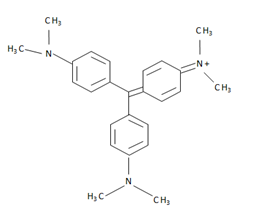
CV structure
The absorbance of a reaction mixture containing CV and NaOH will be proportional to the concentration of unreacted dye still present in solution. The reaction can therefore be monitored and the kinetics studied by measuring the absorbance of the mixture as a function of time.
Since the CV/NaOH reaction follows first order kinetics under the conditions adopted in this experiment, then
ln [CV]t = ln [CV]o – kRt
A plot of, ln [CV] vs. time will be linear and kR can be derived from the slope of the plot.
By using the Beer-Lambert law, if the molar extinction coefficient for CV is known, the concentration of CV can subsequently be derived as a function of time and kR determined.
The rate of many chemical reactions increase exponentially with temperature and can be described by the Arrhenius equation:
k R = A exp -Ea/RT
where A is the pre-exponential factor, Ea the activation energy and R is the gas constant.
The CV/NaOH reaction will be performed at five different temperatures. k R will be derived at each temperature.
Does the CV/NaOH reaction show Arrhenius behaviour?
Experiment 5, the temperature dependence of the CV/NaOH reaction
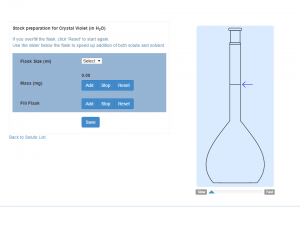
Sim4Web: The Virtual Flask
The Beer-Lambert Law is used in the first part of the experiment which relates the absorbance to the concentration of the sample. Students will make up a series of solutions of CV in water using the virtual flask.
The absorbance spectra of the virtual solutions will be recorded using the spectrometer simulator:
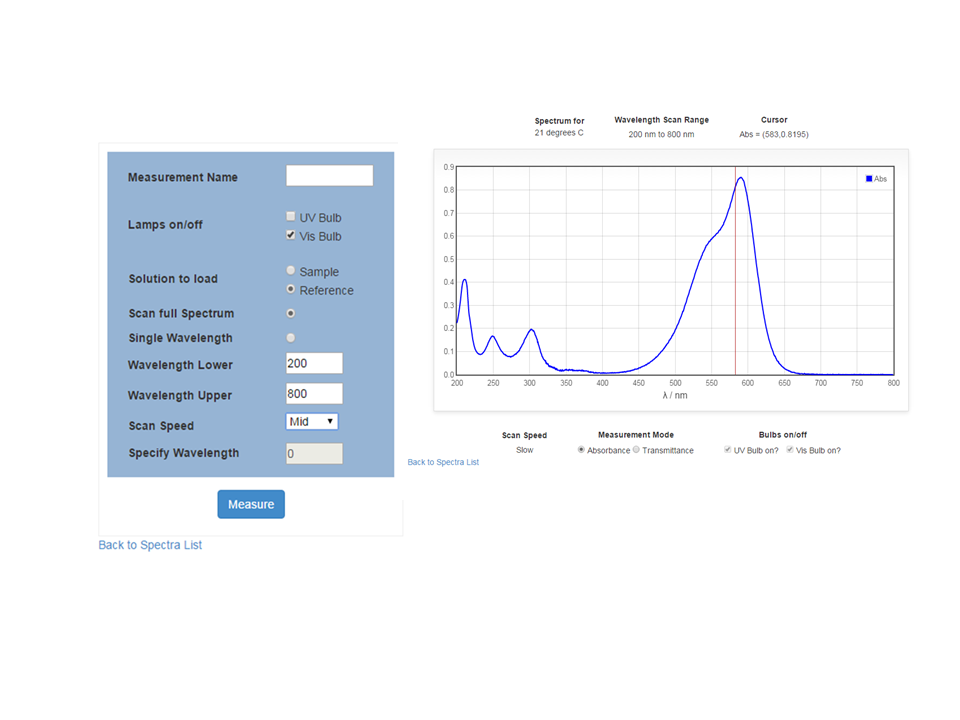
UV-Vis Spectrometer Simulator
A Beer-Lambert plot will be constructed in order to derive the molar extinction coefficient for CV.
The CV/NaOH reaction will be performed in the virtual laboratory at five different temperatures in part two of the experiment. The screen capture/video below shows the experiment being performed at 21oC:
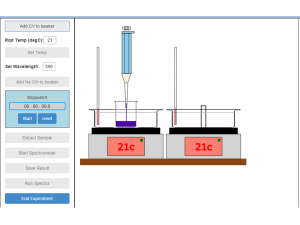
Experiment 5 Wet Bench
Apparatus used in this experiment:
Heater; water bath; temperature display;
timer; 1cm path length sample cell;
thermometer; pipette to release 9 cm3 of CV; pipette to release 1 cm3 of NaOH to start
the reaction.
A sample of the CV/NaOH reaction mixture is extracted from the reaction and transferred to a cuvette. The cuvette is then loaded into the spectrometer and absorbance readings taken as a function of time:
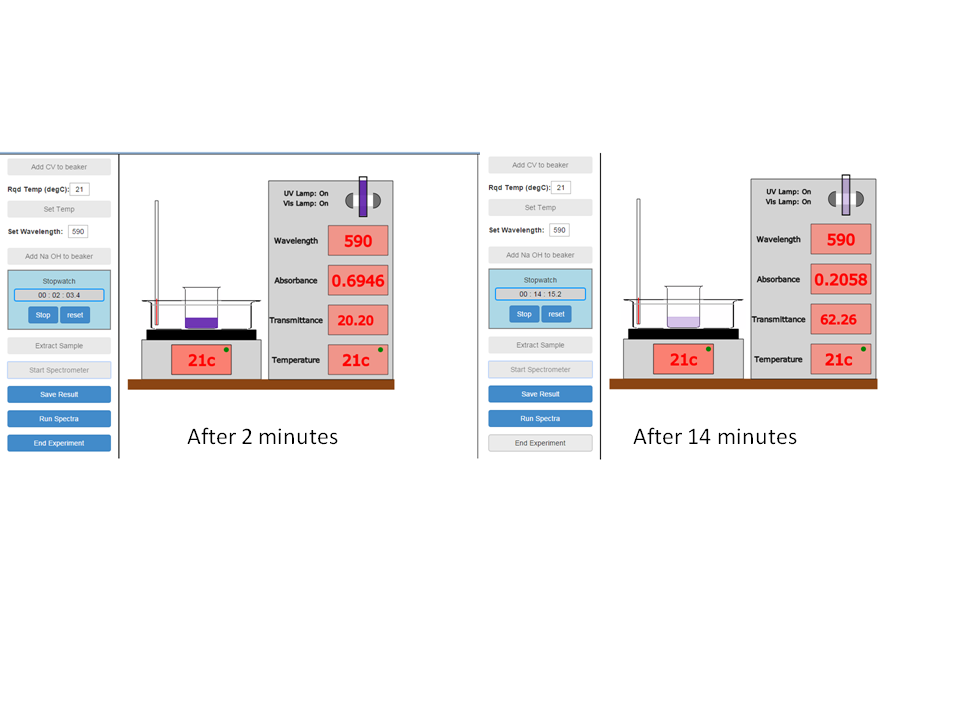
Experiment 5 Wet Bench
Example CV concentration data from the simulator are shown below at 21oC for the CV/NaOH reaction:
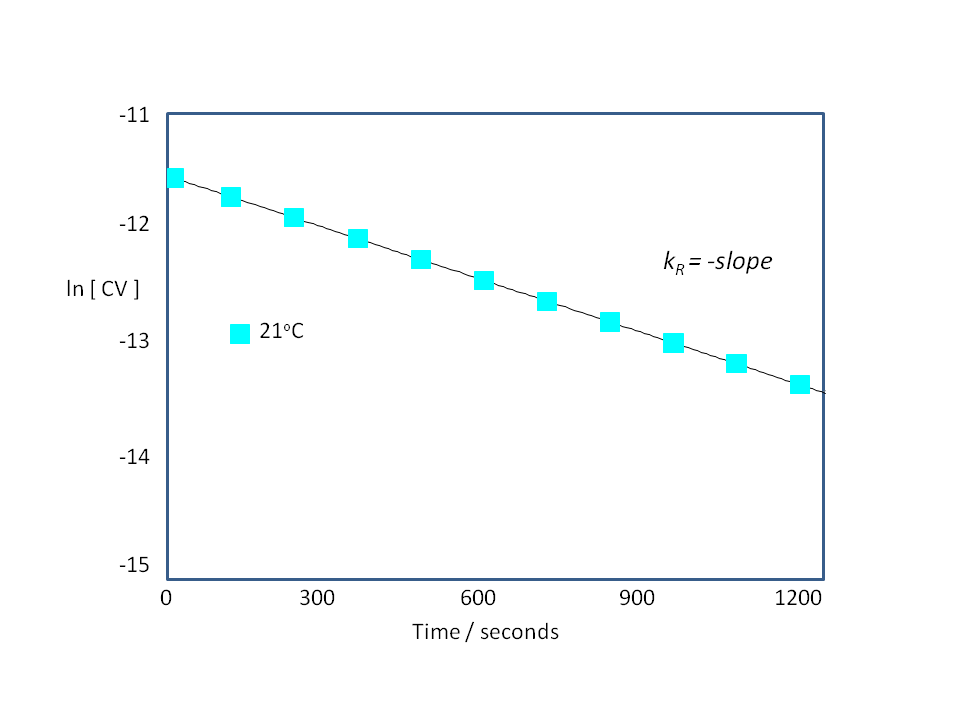
Example CV concentration data at 21oC
Sample Documentation, Look Inside:

Experimental Procedure Preview
Sim Pack 3 Preview
Sim Pack 4 Preview